



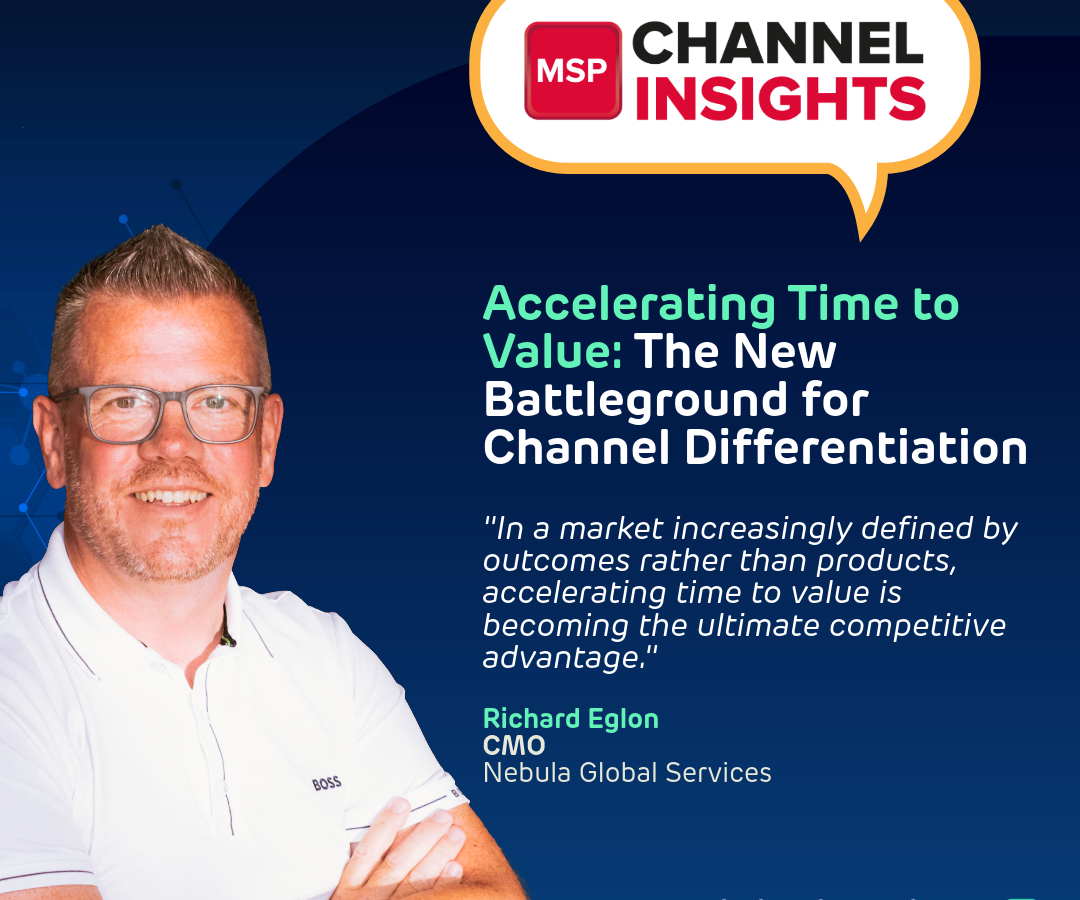
Accelerating Time to Value: The New Battleground for Channel Differentiation
By Richard Eglon, CMO, Nebula Global Services
The technology channel has never faced a more complex operating environment. Economic uncertainty, global supply chain disruption, rising operational costs, geopolitical instability, evolving regulations, and the relentless pace of technological change are placing unprecedented pressure on channel businesses. At the same time, customers are becoming less interested in products and increasingly focused on outcomes. They want solutions delivered faster, with less risk, greater flexibility, and clear commercial value.
In this environment, simply selling technology is no longer enough.
The channel firms that will thrive over the coming years will be those that differentiate themselves not through what they sell, but through how they help customers achieve value faster.
The traditional channel model has largely revolved around products, projects, and procurement. Whilst these fundamentals remain important, they do little to address the challenges customers face today. Businesses are under pressure to accelerate digital transformation, improve productivity, strengthen security, and embrace AI, all whilst controlling costs and demonstrating return on investment.
As a result, “time to value” has become one of the most important measures of success. Customers no longer judge partners purely on technical capability. They judge them on how quickly they can move from strategy to measurable business outcomes. This shift is forcing technology providers to rethink both their commercial and operational models. The traditional approach of lengthy procurement cycles, rigid contracts, fragmented service delivery, and vendor-centric thinking is increasingly out of step with customer expectations. This trend is reflected in Nebula’s own market analysis, which highlights growing pressure from geopolitical fragmentation, supply chain volatility, and increasing demand for faster time-to-revenue across the channel.
Customers want outcomes, not complicated contracts.
Consumption-based services, subscription models, Network-as-a-Service, flexible staffing, outcome-based contracts, and managed service frameworks are enabling customers to access technology in a way that aligns more closely with their business objectives. These approaches reduce barriers to adoption, improve cash flow, and allow organisations to scale more effectively. More importantly, they shift the conversation from cost to value.
Speed, flexibility and execution now matter more than ever
Technology projects are becoming increasingly global, distributed, and complex. Customers expect consistent service delivery regardless of geography, supported by local expertise and backed by global standards. The ability to combine automation with human expertise, standardisation with flexibility, and global reach with local execution has become a significant competitive advantage. Nebula’s own strategy emphasises global delivery, verified engineering quality, customer success obsession, and reducing time to value through scalable service models and local execution at global scale.
No one can do it all alone anymore
No single organisation can be an expert in every technology domain. The most successful channel firms are building sophisticated ecosystems of specialist partners, vendors, consultants, and service providers that enable them to deliver broader outcomes for customers. Collaboration is becoming more valuable than ownership. Customers care less about who delivers a service. They care more about whether it solves their problem quickly, efficiently, and consistently.
The AI era will reward those who move fastest
Whilst AI will undoubtedly improve efficiency and automate many operational processes, it will also raise customer expectations. Businesses will expect faster deployments, more proactive support, greater visibility, and improved outcomes. The channel organisations that succeed will be those that use AI not simply to reduce costs, but to create better customer experiences and accelerate value realisation.
In uncertain times, differentiation becomes a growth strategy
When economic and geopolitical uncertainty dominate the headlines, it is tempting to focus on cost reduction and defensive strategies. However, the real opportunity lies in innovation. By developing new commercial frameworks and modern operational models that help customers realise value faster, technology channel firms can move beyond competing on price alone.
In a market increasingly defined by outcomes rather than products, accelerating time to value is becoming the ultimate competitive advantage.
This article was also published with MSP Channel Insights and Digitalisation World


